EAM CROSS

EAM CROSS
Honoring the Nestorian Christians

Thursday, June 12, 2014

DREAMS, LANGUAGES, COMMUNITY: GIFTS OF THE HOLY SPIRIT


DREAMS, LANGUAGES, COMMUNITY:
GIFTS OF THE HOLY SPIRIT AT PENTECOST
Sermon by The Rev. Canon Dr. Winfred Vergara on the 3rd Anniversary Celebration of the Covenant Between Holy Child (Filipino) Church and St. Joseph’s (Anglo) Church in the presence of St. Philip’s Church, held at the United Methodist Church building at 355 Dixon Road, Milpitas, California on June 8, Pentecost 2014) 

They were gathered in an Upper Room in a house in Jerusalem, praying and waiting. Then something tremendously astounding, something remarkably wonderful, something indescribably amazing happened. A journalist and historian named Luke could only say that it sounded “like the rush of a mighty wind” as  “tongues as of fire fell from heaven and rested upon the apostles.”  

Not unlike Anderson Cooper of CNN doing a “blow by blow” account of Typhoon Haiyan in the Philippines or Brian Williams of NBC doing a rap on You-Tube, Luke of ACTS proceeded to narrate, in staccato fashion, the events that happened: the Holy Spirit had come, the Church was born, and the gifts of the Spirit were given to the first believers of Jesus Christ!

What were these gifts that the Holy ­­­­­Spirit gave?

1.   The Gift of Dreams
The Book of Joel in the Hebrew Scripture earlier said, “In these last days, God declares, I will pour out my spirit upon all flesh and they shall prophesy. The young shall see visions; the old shall dream dreams and whoever calls upon the Lord shall be saved” (Joel 2:28)

Visions and dreams are the gifts of the Spirit. Visionaries and dreamers like Teresa De Avila or Martin Luther King, Jr. or Jose Rizal would say, “I have a dream” but it is not their dream. It is a dream of God planted in their hearts and minds by the Holy Spirit. What distinguished them from other dreamers is that they acted on the dreams of God. Do you have God’s dream? Do you have God’s vision?

When I was a child, I had a dream. It was such a high dream; I wanted to become a bus driver. I wanted to drive on the road and bring passengers from one village to another. Then I had another dream, a higher dream; I wanted to become a ship captain. I wanted to steer the ship and cross the ocean and bring people from one island to another. Then I had another dream, my highest dream; I wanted to become an airline pilot. I wanted to pilot a plane and cross the skies and bring people from one country to another.

Neither of these dreams ever came true. The closest thing for me to driving a bus was driving a 15-seater Holy Child Church Van. The closest to steering a ship was when I ran away from home at age 14 and hid in the kitchen of the ship bound for Manila; and the closest thing to being in the pilot cockpit was when I was upgraded from economy to business class in Cathay Pacific Airlines.

But no, I was mistaken: the dream of God for me was not to be a bus driver, a ship captain or an airline pilot. God’s dream for me was to help bring people from one place to another, not in the physical sense but in the spiritual sense. As a priest, a missionary, a teacher and a pastor, I have driven and steered and piloted people in their spiritual lives, from one degree of spiritual maturity to another. In the final analysis, it is not what you are that matters to God but who you are and whose you are; and it is not your job or profession that matters most but what you do with and for the people whom God has brought into you.

The apostles of Jesus dreamed only of becoming good fishermen. They wanted to catch more fish because sometimes they came home with nothing. They had such lowly dreams that they were amazed when at the advice of Jesus; they dropped their nets and caught so much fish. Is He a magician able to multiply fish from the scarcity of the Galilean Sea? But Jesus had a higher dream for them. “Come, follow me; and I will make you fishers of men.”

On the day of Pentecost, Peter acted on that dream. He cast his net and many fish were caught. He preached one sermon and three thousand men were converted---aside from women and children. What a record! I preached three thousand sermons and was lucky to convert, at least one, my wife! (Yes, she was Methodist and became Episcopalian!)

2.   The Gift of Languages
Luke of ACTS also reported that before he ascended to heaven, Jesus was asked by his disciples, “Lord, will you at this time restore Israel to its former glory? “ Jesus replied, “It is not for you to know the times and seasons which the Father has set by His own authority. But you shall receive power when the Holy Spirit has come upon you, and you shall be my witnesses, from Jerusalem to Judea to Samaria and to the ends of the earth.” (Acts 1:8)

How can the lowly fishermen of rural Galilee witness to the Word of God among the well-educated, intellectually trained and sophisticated people in the city of Jerusalem? They could only speak Aramaic, the dialect of Galilee. Probably they also spoke little Hebrew; or Greek, the lingua franca of the empire during that time.

But the account of Luke is, again, amazing:  Now there were staying in Jerusalem God-fearing Jews from every nation under heaven. When they heard this sound, a crowd came together in bewilderment, because each one heard their own language being spoken. Utterly amazed, they asked: “Aren’t all these who are speaking Galileans? Then how is it that each of us hears them in our native language? Parthians, Medes and Elamites; residents of Mesopotamia, Judea and Cappadocia, Pontus and Asia, Phrygia and Pamphylia, Egypt and the parts of Libya near Cyrene; visitors from Rome  (both Jews and converts to Judaism); Cretans and Arabs—we hear them declaring the wonders of God in our own tongues!” Amazed and perplexed, they asked one another, “What does this mean?” Some, however, made fun of them and said, “They have had too much wine.” (Acts 2:5-13)
 
“They had too much wine” reminds me of my father. He finished Grade 7 before  the Second World War and when the American GI’s came to the Philippines, he was one of the few residents in the barrio who can speak English. But he was so shy; they had to let him drink wine (tuba) before he could speak English. And when he was drunk, he could speak English very well, although in heavy Visayan accent.

Communication is a funny thing. In 1999, the Episcopal Asiamerica Ministry Consultation was held in Hong Kong. One day, during our free time, a group of us from California, decided to find a restaurant outside of the hotel. We found a very small shop, a local eatery that did not even have a display of food or a list of menus. We were all Filipino delegates and none of us spoke Cantonese or any Chinese dialect and we wanted to order chicken. It so happened that the cook, who was also the manager and waiter rolled into one, did not speak English, so we had such a challenging dialogue. I said, “We would like to order fried chicken.” And he could not understand and so, just like what ordinary tourists would do, I spoke very slowly “C-H-I-C-K-E-N.” Now I learned that if the person does not know the language, no matter how slow you speak, still he would not understand it. So I spoke louder, “Chicken!” Well, I also learned that if a person does not know the language, no matter how loud you speak, still he could not understand.

So frustrated of speaking, I decided to change my strategy: I would act out, dramatize a chicken! So I flapped my two arms and said, “wak, wak, wak;tuktulaok: cock-a doodle do.” The cook just laughed but did not understand me. Finally, as my last strategy, I decided to draw a chicken. I took a pen and paper, draw my chicken and showed it to him. We were so happy when he said, “Ahhh!” Finally he got it. We waited. And then he came out with our food. It was not a chicken. It was beef!  (My chicken drawing looked like a cow!)

So there you are: The Rev. Canon Dr. Fred Vergara. One BA degree, two Master’s degrees, two Doctorate degrees---could not even get a chicken from a Chinese cook! When there is no Holy Spirit in you, you can have all the degrees and education in the world but you will fail to communicate.

The simple fishermen of Galilee were filled with the Holy Spirit that when they spoke, the sophisticated peoples gathered in Jerusalem were able to understand them. As a matter of fact, not only that they understood Peter’s sermon; they were “cut to the heart” and cried out, “Brother Peter, what are we supposed to do?” And Peter replied, ”Be baptized, every one of you, and you too, will receive the gift of the Holy Spirit!” And they were baptized that very day! I think that must be the beginning of sprinkler baptism. For how can you immerse or dunk into the water over 3,000 people in one day and there was no river in the city. The river Jordan was quite far away.

3.   Gift of Community
After they were baptized, Luke of ACTS tells us, And they devoted themselves to the apostles’ teaching and to fellowship, to the breaking of bread and to prayer. Everyone was filled with awe at the many wonders and signs performed by the apostles. All the believers were together and had everything in common. They sold property and possessions to give to anyone who had need. Every day they continued to meet together in the temple courts. They broke bread in their homes and ate together with glad and sincere hearts, praising God and enjoying the favor of all the people. And the Lord added to their number daily those who were being saved.” (Acts 2:42-47)

From the gifts of dreams and the gift of languages, there emerged a faith community. The Church was not born on the Day of the crucifixion; the Church was not born on the Day of the Resurrection; the Church was not born on the Day of Ascension. The Church was born on the Day of Pentecost when the Holy Spirit came.

Immediately, ministries came about: teaching and fellowship, holy Eucharist and prayers; healings and miracles; sharing of wealth and possessions; meeting in church and in homes; eating together with glad and sincere hearts.
Notice the last parts, “they ate together with glad and sincere hearts and enjoying the favor of all the people.”

Well, it is possible that the food on their table is more sumptuous and more delicious than the Coffee Hour of our Episcopal churches; but it is more likely that there was fun, there was laughter, there was joy, there was communion---there was---community!

Brothers and sisters, if you desire to have more people in the church, not only that your food must be delicious; you yourselves must have glad and sincere hearts. Do you remember the Sunday School song, “If you’re happy and you know it… then your face will surely show it?” Well, the reason why many of our parishes are dying is because the faces of their parishioners do not show their happiness in Christ! Brothers and sisters, it is not our Anglican stiff upper lip that will draw people to our church. It is our glad and sincere hearts radiating on or faces.

This week, we had a gathering of 70 young adults of color in CDSP in Berkeley: Asian, Latino, Black and Indigenous youth discerning their call. What they brought with them was the consciousness that the younger generation today are “spiritual but not religious.” They believe in God and have a practical knowledge of Christ but they are seeking for an authentic spiritual community. They will not be drawn to churches that are fighting over doctrines or money or wrestle about dogmas or prayer books. They will not be drawn by our intellectualism and via media theology, no matter how lofty they are. They will not be drawn even by our hymns and liturgy even when they are so beautiful and orderly. But they will be drawn by our faces that radiate glad and sincere hearts. Jesus said, “Whoever believes in me, rivers of living water will flow from within them.” The joy of the Lord will be their strength, the peace of God will be in their smiles and the love of God will shine from their lives.

When I became priest-in-charge of St. James Church in Elmhurst, New York last April 1, 2013, I preached my first sermon the Sunday after Easter. I found that the 25 original members, the remnant of what once was a large church, had no resurrection on their faces. I started a joke and nobody laughed. Most of them were not young. They were hurting, they were angry, they were defeated. Years of conflicts, theological and otherwise, were on their minds. Their hearts were heavy. They were skeptical, suspicious and untrusting. I could hear no noise, for there were no children and no Sunday School. I could see no one using iPhone or iPad for there was no youth group. They were as quiet as the cemetery behind our church. But I spoke of God’s dream. That we will become a community again; that we will bear witness to the mission of Christ; that we will be on a new journey; that we will be revived, and renewed, and be born again
I announced that we will become a healing, welcoming and serving church in Elmhurst; that our mission, as written in the Book of Common Prayer, will be “to reconcile all people to unity with God and each other in Christ.”

I believe that was not my dream, but God’s dream, planted in my heart and I prayed that the Word of God sown into their hearts will not return empty but will accomplish that which God purposed and prosper in that for which God sent it.

Today, a year after that April Fool’s Day of 2013, St. James’ membership and attendance have grown from 25 to over one hundred. We now have Sunday School for children; a Healing Service, a Chinese service, a Bible Study, youth and young adults; there is now an Episcopal Women’s Fellowship and the Brotherhood of St. Andrews have learned to cook! We are becoming a community again! And we are reaching out to the outside community with our Coalition Against Human Trafficking; our proposed Community Wellness Program and we are reaching to the world with our Virtual Classroom. And now, we are planning to develop our buildings and properties, so that they will earn revenues to fund our emerging and growing ministries.

Now, when I speak to Holy Child Church and St. Joseph’s Church about buildings and properties, I can immediately read your thoughts. You are saying to yourselves, “If only we have a church building; if only we have enough funds and properties.” But I tell you, there are many congregations that have buildings but they languish and die because they developed an “edifice complex.” They become so attached to their buildings that they do not want to go and reach out to the world. Their buildings have become a fortress or a hiding place from the outside world rather than a command post of their mission to the world. And so eventually, they declined and have to sell off their precious possessions.

I can tell you that in many places, church buildings are being sold away because they have become a burden to support than a resource for growth. When you have visions and dreams; when you speak the language of the Holy Spirit; and when you have community----all the rest will be yours as well. Throughout the 36 years of my priesthood, I have learned this one very important truth:” Where God guides, God provides.” God’s work, done in God’s way and in God’s time, will never lack provision. The Holy Spirit is the Comforter, the Counsellor, the Giver of Life, and the Lord of the Harvest. Seek the anointing of the Holy Spirit---and all these things shall be added unto you!

Conclusion
When I was a youth growing in the ‘60’s, there were two popular songs: one was the song “I Who Have Nothing” composed by Ben King and sung by Shirley Bassey and the other was “Crazy” composed by Willie Nelson and sung by Patsy Cline. “I Who Have Nothing” seems to be the song of Holy Child Filipino Church and every new immigrant congregation. You think you have nothing! But let me tell you that when you look deep inside you, you have something. You have each other: you have a community and you have a dream.

The song “Crazy” seems to be the song of St. Joseph’s Anglo/Euro Church. The first line of the song says, “Crazy, I’m crazy for feeling so lonely.” But I tell you, you are not crazy for feeling so lonely because that feeling would make you want a companion on your journey.

Yes, there are times when our scarcity becomes an asset, when our loneliness becomes a motivation to reach out. Out of scarcity, we become creative and inventive. Necessity is the mother of invention. Out of our loneliness, we desire to find companions. Even God was lonely; he needed someone in His own image; so God created Adam. Adam himself was lonely; the animals and the birds and the bees were not good enough; so he asked God to make an Eve.

Many Anglo Episcopal churches today are small and aging. They are becoming lonely and so they need to reach out to others, especially the growing ethnic immigrants. I am glad that St. Philip’s Congregation which has a building are with us today. Three years ago, Holy Child and St. Joseph’s, two congregations without a building, had signed up a covenant. Do you have to wait for another three years to finally join into a three-congregation covenant? Maybe its time to combine your dreams, your assets, your languages and build a stronger community!

At the risk of revealing your age, those of you who know the song will remember that although “I Who Have Nothing” began with the tone of scarcity, it ended up with the last line that is triumphant and saying, “but it is I, who love you.” And the song “Crazy” ended up by saying, “I’m crazy for loving you.” If you love dearly and care deeply, things will change. 

Authentic love is what makes the church attractive. People will know you are Christians by your love.But it is not enough that you simply reach out to each other in love. Because you have found that you can live together in community and you have found strength in that unity, then you can enlarge the circle of your company. God loves the excitement of big families even as God delights in the intimacy of the small ones. 

So reach out and touch the world with your love; reach out and let your faces radiate the light of Christ. Let your laughter and songs sound the joy of the Lord; reach out and touch the world with your compassionate hearts; reach out and touch the word with your burning spirits. Then the communities of Milpitas and San Jose and the whole Santa Clara County will be attracted to you as the presence of Christ in the world. Then the Holy Spirit, the Lord of the Harvest, will add to your number daily those who are being saved. Then the Holy Spirit, the Giver of life, will provide you with a building, and resources and funding. Then there will be miracles of healing and reconciliation and signs and wonders as the glory of the Lord will shine upon you, and the anointing power of the Holy Spirit will cover you, as the waters cover the sea. Amen. Alleluia!

Friday, May 23, 2014

PORTRAIT OF A FILIPINO ACTIVIST AS A SEMINARIAN


PORTRAIT OF A FILIPINO ACTIVIST AS A SEMINARIAN 

By Fred Vergara

 (Editor's Note: This short story won a prize at St. Andrew’s Theological Seminary in Creative Writing contest in 1976. I think it was because it was the only entry. Just kidding.  Someone has kept it and sent to me. I am intrigued by what I wrote in the past and sharing it with you as it painted the context of martial law in the Philippines and the cynicism of the time. The article written was November 24, 1976 the celebration of St. Andrew’s Festival - Fred Vergara.)


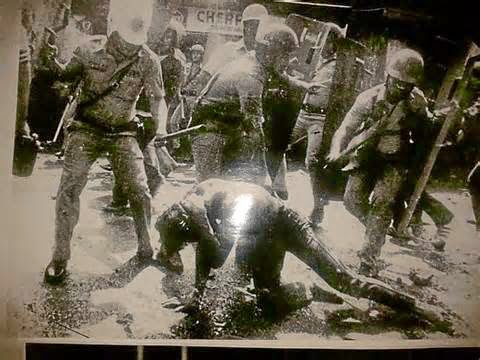
 In the year 1975 traffic congestion in Manila was real. Candido was experiencing its discomforting regularity as when a girl suffers a menstrual cycle. But this last traffic jam was a dysmenorrhea.  It was too irritating to create pain in his lower abdomen.

From the intersection of Taft Avenue, entrance to Jones Bridge in Quiapo, a long line of buses, trucks, jeepneys, taxicabs and private cars were at a standstill. No one could figure out how to escape from the bumper to bumper formation. Several drivers would honk their horns like devils thinking the sounds would make a difference.

From inside the bus, Candido could see black smoke belching from the vehicles. He shuddered at the thought of toxic substances from these emissions: sulfur oxide, carbon monoxide, hydrogen cyanide, nitrogen oxide aside from tar, nicotine foul odor, etcetera. That recent article from Time Magazine about the causes of lung cancer and heart disease flashed in his mind. Ah, this pollution in Manila would shorten the Filipino life span. He made a slight quiver.

He settled his left foot gently on the floor and adjusted his balance. He discovered that he was actually stepping on someone’s shoe and the man was looking at him with sinister eyes.

“I’m sorry, “he mumbled. Could not this insect see that they are all standing like sardines in a Ligo can?
“It’s OK,” the man muttered, releasing a lousy grin. Candido understood this as an insult. Filipinos often cry when they are happy and smile or laugh when they are hurt or angry, a cultural nuance that sometimes baffle the foreigners.  He looked at the man. He can challenge him to a fist fight.

He glanced at his wrist watch. Seiko time: 4:30 P.M. He made a calculation. If the traffic does not move within ten minutes, he would be late for Evensong at their seminary chapel in Quezon City. If the traffic does not move in twenty minutes, he would be late for dinner and marked absent for Evensong. If the traffic does not move in thirty minutes, he would be marked AWOL and be summoned by the Dean of Discipline. Unless he gave a convincing lie, they would know where he went and maybe given a disciplinary action. He grew more impatient. What is happening to the Bureau of Traffic Management?

The traffic still refused to move and the sounds of blaring horns grew more cacophonous. His eyes wandered around but there was no cop directing the traffic.  He overheard the conversation from those sitting in the bus.  One was telling another, “The bullet train, Shinkansen in Japan had started in 1964. Ten years had passed and the Philippines transport system still operates like a calesa.”  


The other passenger, who obviously was a government apologist, counseled him to be patient: “The government is doing all it can to solve traffic congestion and we just have to bear the inconvenience.”  What?  “We are expanding our roads, building more highways and expressways and disciplining our pedestrians. We do not have money compete with Japan but we are purchasing some Japanese buses to fill the transport needs of a growing metropolis.”

So there was the answer to his question.  Could a theological student ask a more sensible one?

The thought of Systematic Theology class began to bug his mind. He wondered why he could not understand theological books. Theological languages are hifalutin and esoteric for common people to understand. Why do they have to write in languages that are hard to understand? Did not God come down from heaven and dwelt among humans and became a servant? Did not Jesus speak in the language that even the dull and ignorant can understand?  But look what these theological nerds did to the Word of God. Macquarie, Bultmann, Moltmann, Hans Kung, Barth, etc. . Bah, Karl Marx could explain salvation history better than these theological freaks!

But back to the point. Perhaps, he was partly to blame for barely passing the course on Systematics and the languages used may not even be part of it. He let off an air of contempt. The image of fat-bellied English missionary came to mind. He once hated this one-man “Department of Liturgy and Music.” He did not like the way a European missionary telling Filipino students that the rituals of their ancestors had no value in Christian worship. He would often make signs of disturbing chapels by pretending to snore or come in and out of chapel and the restroom as if suffering from urinary incontinence.  

Often he would come late or miss the chapel altogether and Father Ulysses could not take it anymore. He warned him, “Gentleman, if you don’t get serious with the Daily Office, you better reconsider your call. The vocation and office of priesthood may not be suited for you.”

He tried to reason out with Father Ulysses.  He felt that the Anglican liturgy was anachronistic to Filipino feudal society. For instance in the exchange of peace, he could not imagine a landlord extending a hand to his farm workers; a Dona shaking hands with her maids; or a haciendero to his sacadas. He would conjure plenty of contradictions. How could Filipino Christians truly be one in sharing the Body and Blood of Christ when they could not be one in sharing a cup of coffee? And how could a rich church live in a society where so much injustices exist?

But Father Ulysses had no stomach for ideological confrontations. His blood pressure would rise and lest he be blamed for his professor’s stroke, he would decide to dismiss with, “Yes, Father; I am too serious about the Divine Office.  In fact, I have already memorized the Te Deum and the suffrages and I can sing the canticles very well.”

He did it! Father Ulysses would calm down.  A master-liturgist, mindful of his Anglican ethos, the now sober Benedictine monk would ponder and waver and then murmured, “There must be something with this kid that I could not recommend him for expulsion.” Candido would have wanted to say; “Don’t you know Father that I am exactly the kind of guy Jesus is looking for.” But he kept it to himself. There was no need to push your luck.

Yes, there were many who were puzzled why he went to the seminary. Comrades who saw him wearing an immaculately white cassock wondered what he had eaten. Conversion?  Penance? Communist infiltration of a Christian institution?

Candido Brilliantes, A.B. Political Science and Journalism. Political activist. Fiery speaker. Militant. Student of Mao. Rabble rouser.  Studying to be a priest?

Nostalgia. Loud, exciting, risky nostalgia. How he would spit at organized authorities. From one campus to another. From one street to another. Protest demonstrations. Sometimes joining mobs in deafening crescendos:  Down with imperialism! Down with Feudalism! Down with Fascism!

Nostalgia. Painful, bitter nostalgia. Martial law. The police brutality. The political prison. Worst, the cutting off of the revolutionary movement, “ten years behind.” The masses refused to bleed. Marcos was too smart to play on their acquiescence. It took over 300 years before Filipinos rose up in arms against Spain and for fifty years they were lulled by American imperialistic subtlety. Just give them something to hold on and they will increase their level of tolerance.  


 Yes, Marcos “New Society” seemed to be working. The masses were being ‘pavlovanized’ by the sweet voice of Imelda and her ‘cultural center.’ The former revolutionaries were turning reactionaries. Doomsday for oppressors did not come. Candido felt that his mind was clogged and could not think anymore.

Oh yes, the beginning of it all was when his mind was clogged with messy activism. Pot sessions, fraternal rumbles, free love somewhere in the campus. The college president, asthmatic and aging, decided to deal with their notoriety. They were expelled from the college but a group of self-styled student movement, held a demonstration for their reinstatement. At their reentry, he pursued what he called “committed journalism.” Chosen editor of the college paper, he pursued radical ideas and imported socialist ideologies. With mind clouded by Marxist ideology, his writings reflected revolutionary means to achieve synthetic ends:” Destroy in order to build;” “Divide in order to unite.”

Then came Leamor. Yes. Leamor, the absorber of his passion, the tranquilizer of his pain, the iota of his eternal delight. She was naïve, pure, utterly ignorant of class struggle. She took out her time for DG’s (discussion groups).  He remembered as she lays naked like the day she was born and saying, “Dids, why don’t you just take an MBA at Asian Institute of Management?  At AIM, you won’t make enemies. And you can be rich someday!” In dreamy eyes, she imagined her future husband getting employed in one of the biggest multinational corporations. She would dream of a mansion, a red car, and a membership in the Blue Ladies Club. She was trying to convince Candido to forget the revolution!

He remembered too how he spat at the pavement of the Episcopalian cathedral and in rage, he responded to her dream with, “Don’t you realize that I am doing for the masses and that includes you?”

Ah, Leamor, the absorber of his passion, the tranquilizer of his pain, the iota of his eternal delight. Frail, virginal, pure until she blurted out in frustration: “Then marry the masses, bastard! You belong to no one and no one belongs to you---except your ideological fantasy!” She fought back her tears and left.

That was the end of it all. When martial law was declared he was among those arrested.  His friends said he was lucky he was released after six months in jail. Some said he raised his right hand and pledged to support the government.  Others said there was a bishop who took him under his custody.

The traffic finally moved and Candido felt a sign of relief. At least, he might be able to reach the seminary for dinner. He might even be able to surreptitiously slip in the chapel before the end of Evensong. Somehow he had come to believe in the power of prayer. Just like a “Hail Mary” pass at American Football games, a prayer in desperation sometimes get good results. Within the two years he had been in seminary, he had learned to pray in desperation. He had a cut his hair short, quit smoking and alcohol, even when other seminarians were learning to do them in seminary.  He even resolved to become abstemious, if not fully abstinent like Father Ulysses.

The seminary is better than Camp Crame, he whispered to himself. Father Ulysses could be right. How wonderful it is when the prodigals come home and repent.  And what joy would a Filipino Church have when one spiritual leader who came out from filth would rise up as an instrument of God’s cleansing power. He could even become the Bishop of Manila. With miter and staff, he could pronounce absolution and influence social change. He could rub elbows with the mayor of Manila and even encourage Imelda in her beautification campaign. He could organize a faith-based coalition to call for solutions to traffic congestion and to combat air pollution!

He was about to get lost in his fantasy and daydreaming when he was awakened by a violent sound of colliding cars. Frenzy broke loose inside the bus when the driver hit the brakes just on time before joining the pile up as multiple cars crashed on rear end collisions. Women shrieked. Men ogled at what was happening. Traffic stopped again and a loud voice was heard. “P..ina mo! Saksak ka ng saksak; lumabas ka riyan!”  The taxi driver was mouthing a Tagalog curse addressed to the man in Mercedes Benz. His taxicab made in Japan was no match to the German made Benz. It was smashed!

I said “P…ina mo! Lumabas ka riyan!” Road rage. The taxi driver was blurting out foul language.
From the dark tinted Benz, came out a man in dark suit. With his bodyguards. Candido made a remark in the bus. Burgis! Politico!

Upon seeing the man with his bodyguards, the taxi driver was halted. He should not have uttered those dirty words. But he was hurt and his taxi was smashed. And there was no time to run.

The burly body guards took hold of the taxi driver on both arms and the man began slapping the taxi driver. What did you say? Take it back or I’ll kill you! Then he punched and kicked as bodyguards restrained the bleeding taxi driver, writhing in pain.  From the bystanders, there was no one who stood up to succor. Everyone was simply watching the assault that was taking place.

The scene was too much for Candido. He felt hot anger in his belly and his eyes grew wild. Seizing a metal pipe from under a bus seat, he rushed to the aid of the taxi driver and wildly swung to the man in dark suit. One of the body guards drew a gun but Candido was already raging with uncontrolled madness, unleashing his fury. He felt like an archangel anointed by God to execute judgment against the oppressors. He felt exalted from his lowly position and given the righteous mission to defend the poor and punish the iniquities of the rich. In his exultation he did not hear the explosion of the gun. He did not even feel the burning pain of the bullets piercing his body. But as he fell to the ground, he saw a glimpse of Jesus’ body on the cross, dirtied, blooded and… dead.

Sunday, May 4, 2014

EMMAUS: Welcoming the Stranger, Walking in the New World


EMMAUS WALK: Welcome the Stranger and Live in a New World (Text: Luke 24:13-35)
(Sermon of the Rev. Canon Dr. Winfred B. Vergara. St. James Episcopal Church, Elmhurst, NY.5.4.2014)

1st Century Israel: It was evening of the day of Jesus’ resurrection. Two disciples of Jesus were walking from Jerusalem to Emmaus. One was named Cleopas and the other was not identified. Emmaus was seven miles from Jerusalem so it was quite a long walk. What happened to them on their way would warm their hearts, transform their lives and revolutionize their ministry.

What exactly happened on their way to Emmaus? Three things happened: A stranger walked with them; the stranger broke bread; the stranger turned out to be Jesus!

21st Century New York: What is the significance of Emmaus to our own lives today? Where is our Emmaus? How do we walk with God in this new world?

A.     A stranger walked with them
 We live in a world where we are taught to fear the strangers. We tell our children not to talk to strangers. We are wary of strangers. They may bring us harm. They may bring us disease. They may bring us burdens. They may disturb our peace. They may be a threat to our security.

The history of immigration in this country was in some way tainted by this fear of the stranger. “These new immigrants will take away our jobs and will become a burden to our economy.” So we build walls, we barb wire  our fences,  we strengthen our borders. We tighten our immigration policies.

Some of our fears of the stranger issued itself in the form of racist laws and discriminatory policies. On May 6, 1882, the U.S. government issued the Chinese Exclusion Act. Signed by then President Chester Arthur, it was one of the most notorious restrictions in United States immigration history. The Act not only prohibited immigration of Chinese laborers but also deported many who were already here. After they helped America to develop their mining industry and built its transcontinental railroads, the Chinese immigrants were branded as “yellow peril” and sent back to China.  The Act was initially intended to last for ten years but continued for many years until repealed in 1943.

On February 19, 1942 following the bombing of Pearl Harbor and the outbreak of the War in the Pacific, U.S. President Franklin Delano Roosevelt issued Executive Order 9066. It was known as the “the Japanese Internment Act.”  On May 3, 1942, General DeWitt ordered all people of Japanese ancestry to be incarcerated in various Internment Camps in remote areas in the country. Overnight, 110,000 Japanese immigrants--- 62% of them American citizens--- were removed from their homes and herded into concentration camps.

America used to be known as a “Christian country” but because of fear, we forget what the Bible says in Exodus 22:21:"Do not oppress a foreigner; you yourselves know how it feels to be foreigners, because you were also foreigners.” Because of fear, we forget the inscription written on the Statue of Liberty, a poem from Emma Lazarus:

 Give me your tired, your poor, Your huddled masses, yearning to breath free, the wretched refuse of your teeming shores. Send these, the homeless, tempest tost to me,I lift my lamp beside the golden door.”

2. The Stranger Broke Bread
So it is a credit to the disciples of Jesus that they welcomed the stranger to walk with them. At this point of their lives, they felt they had nothing to lose. Their leader Jesus had died and they were lonely. This man whom they looked as the deliverer was rejected, arrested, crucified, died and was buried. They felt empty, their hearts forlorn and their hopes droop. What they needed most was a companion on the journey. They forgot their fears; they become vulnerable and they opened their lives to the stranger. Not only that they allowed the stranger to walk with them; they sat down at table and shared their food.

Asian theologian D. T. Niles wrote, “Evangelism is a beggar telling another beggar where to find bread.” When Jesus saw the crowd, he had compassion for they were harassed and helpless, like sheep without a shepherd (Matthew 9:36). When Christianity was introduced to India, the first ones who responded were the Dalits or the “untouchables.” They were the oppressed, the massa perditionis, the marginalized, the outcast of society.  It is when you feel vulnerable that you are open to the move of the Spirit. It is when you feel you are a stranger that you are kind to strangers; it is when you are wounded that you care for the wounded. Because you remember that you were a foreigner once, that you are also kind and welcoming to the foreigner.

Not only that the disciples listened to his story; they also invited the stranger to dinner.  And the miracle happened! As this stranger broke bread, their eyes were opened and they recognized him as the risen Christ! In the past, their ancestors had welcomed the strangers who turned out to be angels; now, they had welcomed a stranger who turned out to be the Christ!  

As the risen Jesus vanished from their sight, they said to themselves, “Did not our hearts burned within us as while he talked with us on the road and opened the scriptures to us?” Unable to contain this joy, they hurried back to Jerusalem and told the other disciples that Jesus had risen from the dead.

3. The Stranger turned out to be the risen Christ
The experience of the two disciples on the road to Emmaus, the lessons they learned from the stranger and the Holy Communion they partook from the risen Christ, were the rewards they received for being open and welcoming to the stranger. Their ears heard the Good News because they were open; their hearts were warmed because they were not hardened; their eyes recognized Jesus because they were ready to see the miracle.

As they shared the Good News, they were willing to enter a new world, a world they have not known before. The Bible would later say that the risen Christ took them as far as Bethany to be a witness to his ascension into heaven. Jesus commissioned them to go and make disciples of all nations and to believe that He will be with them to the ends of the world (Matthew 28:19). Jesus summoned them to live a life without fear, to enter a world where death has no more dominion, a world where all things are possible ----and to a new life can be lived in all its fullness.

Conclusion
Let me now stretch your imagination and ask: What is this new world in our context? What is our road to Emmaus? For me it is the world of the internet. It is a world that for a long time, I had ignored. I grew up in the world of manual typewriters and rotary phones; of transistor radios, sewing machines and black and white TV’s.  In my over sixty years of life, I have experienced that has evolved: from an agricultural era, to industrial era and now the computer-internet era.

 The Emmaus that we are in is changing very rapidly. When I came to New York in 2004, I rode in the subway train and there were still people still looking at me. But now, nobody is looking at each other---because everyone is busy with their iphones or smart phones: talking, texting, twitting or checking their Facebook and other social networking.

Steve Jobs, the inventor of Apple’s iPhone is now dead but the revolution he started continues. He had invented the iPhone; IPod; and iPad. And I invented the iSleep; iSnore and iIgnore. But now, I can no longer ignore it.
 In fact, I am already addicted to this little thing, and so with millions of other people as well. And I am also addicted to Facebook, which is now the second largest population in the world!

This little iPhone has now become my constant companion, my significant other. It is with me when I sleep and when I rise. It goes with me when I fly 36,000 feet on the plane; it is with me when I go to the deepest part of the earth, like Death Valley, California; it is with me when I fly to the uttermost part of the sea, which is Sabah, Malaysia.

My wife should get jealous with my iPhone Girlfriend, but she does not mind, because she also has Mr. Smart Phone, the Galaxy 5, Android. The smart phone can do things equally, like the iPhone. It can find us friends via Facebook; it can give us community via Google+; it can excite us with news and trivia via Twitter; it can connect us with family and friends via Skype; it can put us into group discussion and meetings via Zoom or webex.
This, now, is the world in which we live. We can hate it or love it; we can curse it or bless it; we can reject is or embrace it; but we can no longer ignore it!

So how should we live in this new world? How do we deal with this stranger in our midst?
Do we reject it like the Pharisees and call for its crucifixion? Or do we welcome it like what the disciples did on the road to Emmaus?

Today, our Senior Warden will show us our new Virtual Classroom (our partnership with the Asiamerica Ministries and the Diocese of Long Island of The Episcopal Church). This classroom is equipped with the latest of technology. Through this classroom, we can reach people not only inside but outside the walls of the church.  We can teach, proclaim and share our faith to people abroad as well as receive teaching from abroad. This is our classroom without borders!

It was in 1739 when Anglican clergyman (who founded Methodism) John Wesley uttered this famous phrase, “the world is my parish.” Today, this prophecy has become a reality.  The world parish has no physical boundary. Through the internet revolution, we can be both a local church and a global church; both a real and virtual church; a physical church and a digital church-reaching the uttermost part of the earth.
St. James Multicultural Parish in Elmhurst, New York  stands today as an example of a church for the world. We shall have congregations within and without. We shall have congregations in Queens as well as in cyberspace.  Like the disciples on the road to Emmaus, we shall walk with the stranger, offer hospitality to all foreigners, and break bread within and beyond time and space. In this openness and willingness to learn to live in this new world, we will discover new tools that will revolutionize our ministry, revitalize our church and move us forward to the Kingdom of God.

Brothers and sisters: Welcome this new world and expect a miracle! Amen.